


Jasmijn Derckx
PAX44 – Arnhem’s gift to the world by a message in a bottle
“If, in years to come, you meet a man says he was in Arnhem, ’raise your hat to him and buy him a drink”
Alan Wood, war correspondent for the Daily Express
Magical moments in history
In the darkness of wartime, people look for a glimmer of hope. Small gestures or seemingly insignificant events sometimes turn out to be the greatest magical moments in history after the end of the war in the context of the battlefield.
Many people know the story of the legendary World War I football match. On Christmas Eve 1914, the guns in Ploegsteert in West Flanders were silent. On both sides of the front line, German and Allied soldiers climbed out of the trenches. They wished each other a happy Christmas and exchanged gifts. Here and there, games of football were played mainly between the Belgians and British. It was the ultimate Christmas spirit, a glimmer of humanitarian hope in dark days.
The Netherlands now also has such a magical story. I take you on a journey to Arnhem in the September month in 1944.
Oosterbeek
We start near Arnhem in the lovely artists’ colony of Oosterbeek, a beautiful and green village on the Rhine. My cradle was at Paasberg 3 in Oosterbeek in 1970. The house was a 1906 semi-detached with a high pointed red roof and large windows on the front facade. It was the first real house my parents bought as twenty-somethings.
My father came from Meijel, Limburg. There, as a child, he had experienced the ‘Battle of Meijel’ in the Peel where Meijel was completely destroyed. My mother, whom he met in Nijmegen, experienced the surprise bombing of Nijmegen as a child in which my grandparents’ house burned down completely. They lost everything and fled with their family of seven children to a farm in the Ooijpolder.
As a child, I grew up with the shadow of war. Not only because of my family history but also because I grew up in an environment where the war past was still so clearly visible and tangible.
My mother walked with me as a baby in the pram through park Hartenstein; we lived around the corner from this park. In the middle of the park is a large white villa, the former headquarters of General Urquhart during World War II, today’s Airborne Museum. There, hundreds of soldiers were nursed in the basement, many of them dying in the vaults of this stately vila.
In the room at the back of the basement, General Urquhart decided on the Battle of Arnhem. As divisional commander in chief, he was in charge of the 1st Airborne Division. As commander of the 21st Army Group, Montgomery was responsible for the entire Operation Market Garden, while General Dempsey was responsible for the 2nd Army.
The battle for the Rhine bridge in Arnhem
In August 1944, the Allies realised that only one more major action was needed to drive the Germans out of the Netherlands, victory seemed achievable within weeks. The aim of Operation Market Garden was to establish a bridgehead across the Rhine. The Allies would then advance further across the Veluwe. The units were to advance to the Zuiderzee (IJsselmeer) in order to cut off the western Netherlands. This would make it impossible to fire V1 and V2 rockets at Antwerp and England from the western Netherlands and so cutting off supply lines. Furthermore, north of the Rhine, the route lay open to the political heart of Germany – Berlin – and its industrial heart – the Ruhr region.
British General and Field Marshal Bernard Law Montgomery, Viscount Montgomery of Alamein, simply called ‘Monty’, decided on Operation Market Garden in September 1944. This would allow the British to advance into Germany’s industrial heartland, the Ruhr. After some hesitation, Commander-in-Chief General Dwight D. Eisenhower, agreed to this bold plan on 10 September.
The operation involved three divisions and a brigade. The 101st US Airborne Division was deployed around Eindhoven, the 82nd US Airborne Division around Nijmegen, and the 1st UK Airborne Division, together with the 1st Polish Independent Parachute Brigade Group, around Arnhem. Each unit had its own objective, and only the British and Poles were tasked with reaching Arnhem.
General Urquhart, stationed at Hotel Hartenstein, which today houses the Airborne Museum, was in charge for the Airborne Operation. Hotel Hartenstein was chosen by chance as the temporary headquarters. It had initially been planned to be in Arnhem. In just a few days, this plan was drawn up. In retrospect, this proved to have been too carelessly short.
Operation Market Garden was scheduled for 17 September 1944. The Americans and the British 2e division were to reach Arnhem via Nijmegen and Eindhoven. The 1st Airborne Division, including the 1st Polish Independent Parachute Brigade Group were only tasked to reach Arnhem. The weather forecast was not good.
The people of Arnhem saw a long line of aircraft appear over Arnhem. At that point, there were hardly any German troops there. They were rushed in at short notice. There were, however, a number of units, including an SS training battalion in Wolfheze under the command of SS Major Sepp Kraft.
On Sunday 17 September, more than 300 gliders carrying the Division’s troops and the 1st Airlanding Brigade landed, followed immediately by the 1st Parachute Brigade. Both the paratroopers and the gliders landed on the heathland west of Wolfheze and north of Heelsum.Nearly 400 gliders landed on Dutch soil. Meanwhile, the Germans were already hastily mobilising their troops. By a stroke of stupidity, they had got hold of an original battle plan that allowed them to mobilise in a targeted manner. Although the plans had fallen into German hands, little or no use was made of them here. General Kurt Student in Vught had the plans.
House-to-house fighting ensued. The Germans tried to set fire to the houses, total chaos ensued in Arnhem and Oosterbeek. The area became one big battlefield
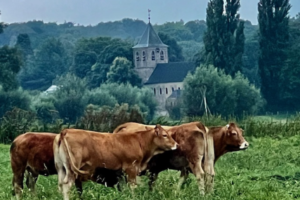
On Monday18 September, another large number of aircraft flew from England towards Arnhem, the weather was good and there was little resistance along the way. A second drop of the 4th Parachute Brigade followed on the Ginkelse hei. Like on Sunday 300 gliders landed at the same location near Wolfheze with a great part of the division. The Germans were able to wait for the drop and shot many paratroopers out of the sky. Gliders were shot out of the sky. Paratroopers were shot out of the sky like birds or ended up wounded in the trees. There was heavy fighting from house to house, garden to garden. Ammunition ran out and every street corner became a trap. The British lost their grip on the bridge. The men hid in the houses near the bridge and the St.Elizabeth Gasthuis in Arnhem.
On 19 September, there was heavy fighting around the bridge at Arnhem and in Oosterbeek. Eventually the road to Arnhem from Nijmegen lay open but the Germans had regained control of the Arnhem bridge. The British ran out of water and food in Arnhem and were almost out of ammunition.
During a brief truce, the British wounded in captivity were handed over to the Germans, including Frost. There was heavy fighting in the perimeter formed on 19 September around Oosterbeek. On the morning of 20 September, of the ten thousand landed troops of the 1e Airborne Division, only three thousand remained in Oosterbeek and five hundred at the bridge.
It was not until 20 September that the ground units (Garden Group) reached Nijmegen. The US 82nd Airborne Division crossed the Waal in small boats (Julien Cook), after which a combined force of US paratroopers and British ground troops took control of the road bridge at Nijmegen.
On 21 September, late in the morning, the Germans shot away the last British resistance in Arnhem. There was heavy fighting in Oosterbeek with help from the Poles. A hell broke loose in Arnhem, Nijmegen and Oosterbeek. Due to the weather, the Polish brigade only able to land on 21 September at Driel, at a new landing site. The original site, south of the road bridge, was in German hands. This was only two-thirds of the brigade. The rest were still in England due to a miscommunication. They arrived at Groesbeek a day later.
After the so-called Conference of Valburg (24th of september) general Sosabowski was forced to put a part of his Polish troops into the crossing of the Rhine at Driel/Heveadorp. At the same time this was the beginning of making Sosabowski and his heroic troops the scapegoat of the debacle of Market Garden..
On 24 September, the decision was taken to evacuate the division. On 25 September, Urquhart was informed of this in a letter brought by Lieutenant-Colonel Myers from General Thomas’s headquarters (on the south bank of the Rhine) by the 21st of that month, Lieutenant-Colonel John Frost, commander of the 2nd Parachute Battalion, had already been forced to surrender to the Germans on the Arnhem Rhine traffic bridge.
The Poles led by general Sosabowski, made two attempts to cross the Rhine. The first time, around 50 men made it across; the second time, 150–200. In Oosterbeek and Arnhem were heavy fights.
In the night of 25-26 September the evacuation of the remnants of the British Division and the Polish Brigade took place during Operation Berlin. They used the so called White Ribbon route, a white ribbon stretched across the route of the General Urquhart’s headquarters Hartenstein via the forests and the Rosandepolder to the river Rhine.
Many wounded and survivors were brought to the rectory next to the Old Church in Oosterbeek, where the ‘Angel of Arnhem’, Mrs Kate ter Horst, and her family cared for them. The mass grave came into being after Operation Berlin, when the fallen British and Polish soldiers had to be buried in and around the Ter Horst family home on the orders of the Germans. This was carried out by Jan ter Horst and Pastor Bruggeman. Fifty-seven bodies were buried in the garden. Next to the house was a mass grave in the garden, later, the many fallen soldiers would be reburied at the Airborne Cemetery in Oosterbeek.
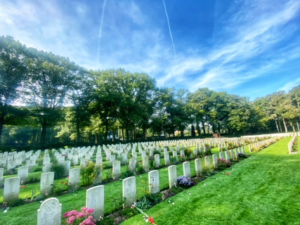
In the end, the plan failed and on 26 September 1944 the bridge at Arnhem turned out to be ‘A Bridge too far’. As Winston Churchill put it, ‘it was a heroic failure’.
The losses were high.
The figures for British and Polish casualties during the Battle of Arnhem are as follows:
killed in action: 1,485
taken prisoner: 6,525
safely evacuated: 3,910 (2,400 British from Oosterbeek, 1,486 Poles from Driel)
The intertwined history in my heart
My first breath as a baby was in the delivery room at St Elizabeth Gasthuis. This hospital is close to the aforementioned bridge in Arnhem. In the room where I breathed my first air as a baby in May 1970, many British and Germans breathed their last in September 1944. The hospital was run by German nuns during World War II. Germans, Dutch and British all worked there. The hospital was first in British hands, later recaptured by the Germans. Both the British and the Germans and Dutch brought in the wounded. Here there was no time for war, only time to save lives.
I was baptised at Tafelberg in Oosterbeek, where the bloodstains on the tiles testified to its function as an emergency hospital. I learned to walk on the narrow paths in Hartenstein between the trees wounded by shrapnel. As a highly sensitive girl, I ‘spoke’ to the still wandering souls of the fallen soldiers I encountered daily in the Oosterbeek woods. It was the most normal thing in the world for me.
The big Protestant school, the Paasberg School, which was right opposite our house, was an emergency hospital during Operation Market Garden. As schoolchildren, we put wads of paper in the many bullet holes in the walls of the classrooms. Around the corner from our street was the hotel ‘Schoonoord’ where many wounded were also cared for during the September days of 1944.
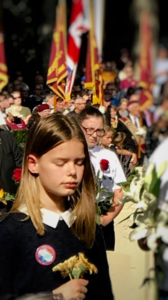
Still every year in September, I try to make time to walk the Airborne March and go to the annual commemoration at the Airborne Cemetery where I used to be flower girl. And every year I still get goosebumps when the first words of the hymn ‘Abide with me’ are sung.
Last year, I was at the Airborne Cemetery on Christmas Eve, in an icy cold. In the mud and rain, young and old from Oosterbeek came to place a candle on the graves. The thoughts of the many fallen are still kept alive.
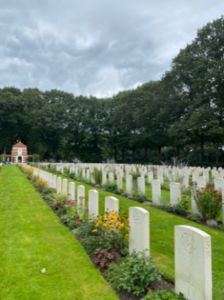
My parents used to always host Airborne veterans in their house like Harry Westwood and Bill Hewitt. In 1999, my parents built a new house right opposite the former Hotel Dreijeroord (‘The White House’), where there was heavy fighting by the 7th Battalion of the King’s Own Scottish Borderers (KOSB). As the name suggests a battalion-sized unit that took part in the fightings as a part of the 1th Airlanding Brigade. A plaque on that house read: ‘Last stone laid by Marc Gijsbers (my son) and Airborne Veteran Harry Westwood’.
When Charles Brussee, friend of Pax founder John Davies asked me to write this article, of course I did not have to hesitate for a moment. The history of Arnhem and Oosterbeek is intertwined with my heart. He suggested I enter into conversation with John.
In the first conversation with John, my feelings were immediately confirmed by the special story behind this whisky. Soon I knew that really was a message in a bottle that the world desperately needs at this time.
Compassion
I try to imagine what it looked like during the bloody September days of 1944. I only have to think of a war film and I can already see the image of the deserted streets, the chilling tension of looming troops, the sound of planes in the distance, the fear, destruction and utter dejection of people on the run. But the smell of fearful sweat, the damp cellars where Arnhemmers took shelter, the smell of gunpowder vapour in the streets, the rotting bodies, I thankfully cannot imagine. It must have been hell on earth to have to fight in Arnhem in those September days.
The story of PAX44
A large patrol of Waffen-SS soldiers led by SS-Hauptsturmführer (captain) Hans Möller of SS-Panzer-Pionier-Bataillon 9 trapped a group of British Paratroopers in the upstairs rooms of a house between Urquhart’s headquarters at Hotel Hartenstein and Hotel Tafelberg in Oosterbeek as they retreated from the battle for the Arnhem Bridge. The area, known as the Perimeter, was horrific, lit by the flame throwers carried by the Captain’s engineers, turning it into a witches’ cauldron (the Germans named it the Hexenkessel). Then the area fell silent for a moment, the sound of machine guns stopped. Instead of fighting, both sides proclaimed a moment of truce ‘PAX’.
The starving Britons lowered a bottle of whisky down a rope to the German troops and in return received German caffeine-rich chocolate rations. A moment of humanity and fraternisation. A gesture of peace could be that simple. This scene is described in ‘It never snows in September’, the German View of Market-Garden and The Battle of Arnhem, September 1944’ by Robert J. Kershaw (1990). In chapter 20, The Witches’ Cauldron, Kershaw tells how Hans Möller remembers that horrors could be interspersed with lighter moments, as when an occasional ‘bottle of whisky lowered on a rope’ was exchanged in a deadlocked position between the floors of a jointly occupied house, with ‘my engineers sending up chocolates in return’.
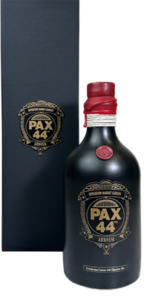
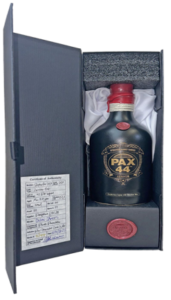
A bottle with a message
When the founder of PAX44 whisky heard this story, he wanted to capture this special moment and came up with a Presentation Edition whisky that incorporates this story of the exchange of whisky & chocolate during a moment of Pax. With notes of dark cocoa sparkling in your mouth, it keeps the memory of this story alive.
The Presentation Edition of PAX44 is made with a 12 year old single malt matured in Port barrels before the raw, fermented cocoa nibs add flavour and meaning. The whisky has an alcohol content of 44% and bottled in 500ml handmade bottles. A limited edition of 44 bottles was released in 2023. Each bottle of this Presentation Edition comes in a collectible box, encased with parachute silk and a ‘live’ (not fired) World War II bullet found near Arnhem and Oosterbeek. These bottles have since been presented to General Peter van Uhm, Major Marco Kroon, the Airborne Museum Oosterbeek, Schoonoord in Oosterbeek, the VC Gallery in Wales, the Loggerhead Cocktail Bar in Kyiv, FC Vitesse, Café Unibar, Airborne Tulip Memorial and many others. I’m also a proud of been given one of these special bottles.
An Arnhem Edition whisky & chocolate was released in September 2024. This is a triple distilled premium whisky with soothing hints of smooth, rich chocolate. These Warrior Spirits are tributes with a flavour forged in the fire of the Witches’ Cauldron. The brand represents humanity, moral courage, standards of behaviour, brotherhood and sisterhood. Profits support projects to manage post-traumatic stress.
On receiving his bottle Major Marco Kroon wrote, “PAX44 is a symbol of the humanity of every warrior who has correctly calibrated the moral compass.”
PAX, the goddess of peace
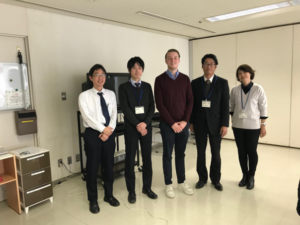
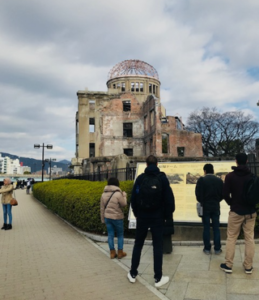
When my son Marc was studying at Keio University in Tokyo in 2019, I visited him and we travelled around Japan together for a week. A few months before I left, we talked about the upcoming trip and he asked me the question: ‘how were those residents of Hiroshima actually able to rebuild their city after something so terrible. How is a human being able to overcome something so terrible?’ I pondered this question and decided to put it to the mayor of Hiroshima. I received a response from his secretary within a week. The mayor was out of town in the week after New Year but of course we were welcome at the ‘City Planning and Peace Promotion Divisions’ for a lecture.
We were welcomed by a delegation and given a two-hour presentation with stories about and photographs of a totally destroyed city, 92% was destroyed by the all-destroying fireball of over a million degrees of heat. A photo of just a shadow of a human being, a melted bicycle, a watch that stood still at the hour of the atomic bomb’s impact were fierce witnesses of total destruction. It made quite an impression to hear how the people of Hiroshima were helping eachother, the mothers who baked litte pancakes on the streets (called okonomiyaki) and how the human spirit of surviving build the foundation for the rebuilding of the city. After this presentation, we were asked if we wanted to be ambassadors in the fight against nuclear weapons. A resounding ‘yes’ was our answer.
2024
It is extraordinary to realise that now in 2024 there is still an arms race going on. Why don’t we learn anything from our history?
More than 100 wars have been started since 2013. The number of conflicts worldwide has increased by more than a quarter in the past year. One in six people live in a war situation. It is estimated that there are currently 13,000 nuclear weapons in the world, of which nearly 4,000 are operationally deployable.
Peace is a precious asset. In the coming decades, our moral compass will increasingly be called upon when it comes to distribution of food, water, land, fuel and respect with regard to religious beliefs. I believe the role of women is essential when it comes to conflict management.
PAX, ‘mercy, peace’ is a concept that everyone could learn from an early age. More than ever, women could play a role when it comes to promoting world peace.
The mission of PAX44
A ‘message in a bottle’ is the mission of PAX44. The humanitarian story of the exchange of whisky & chocolate during a moment of Pax is a gesture of peace not seen since the football match to herald the Christmas truce of 1914. Every sip, every telling of the stroy of PAX44 inspires moral courage and the belief in the warrior’s moral compass.
Full circle
While writing this story, I was looking for historical material. And to my great surprise, I found a photo of the house in Oosterbeek where I grew up, Paasberg 3. A house close to where the story of PAX44 took place. As it turned out, it used to be divided into two shops. In the right half of the house, where I lived, there was a liquor store. On the left side, now Paasberg 5, there was a tobacco shop with a big sign on the facade saying ‘Van Houtens’ cocoa’.
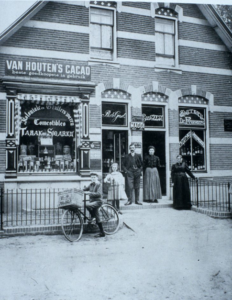
My cradle was between booze and chocolate, surely that cannot be a coincidence.

Lest we forget
Jasmijn Derckx, Den Haag augustus 2024
Met dank aan Marcel van Hemert voor de aanscherping van de militaire details
Bron: *It never snows in September, Robert J. Kershaw.I Da Capo Press september 1996
ISBN-10-1885119313